


How to Size and Calculate kVA Rating for 3-Phase Industrial UPS in Manufacturing Facilities
A step-by-step engineering calculation guide to correctly size a 3-phase industrial online UPS, factoring in inrush currents, non-linear harmonic loads, and battery autonomy.

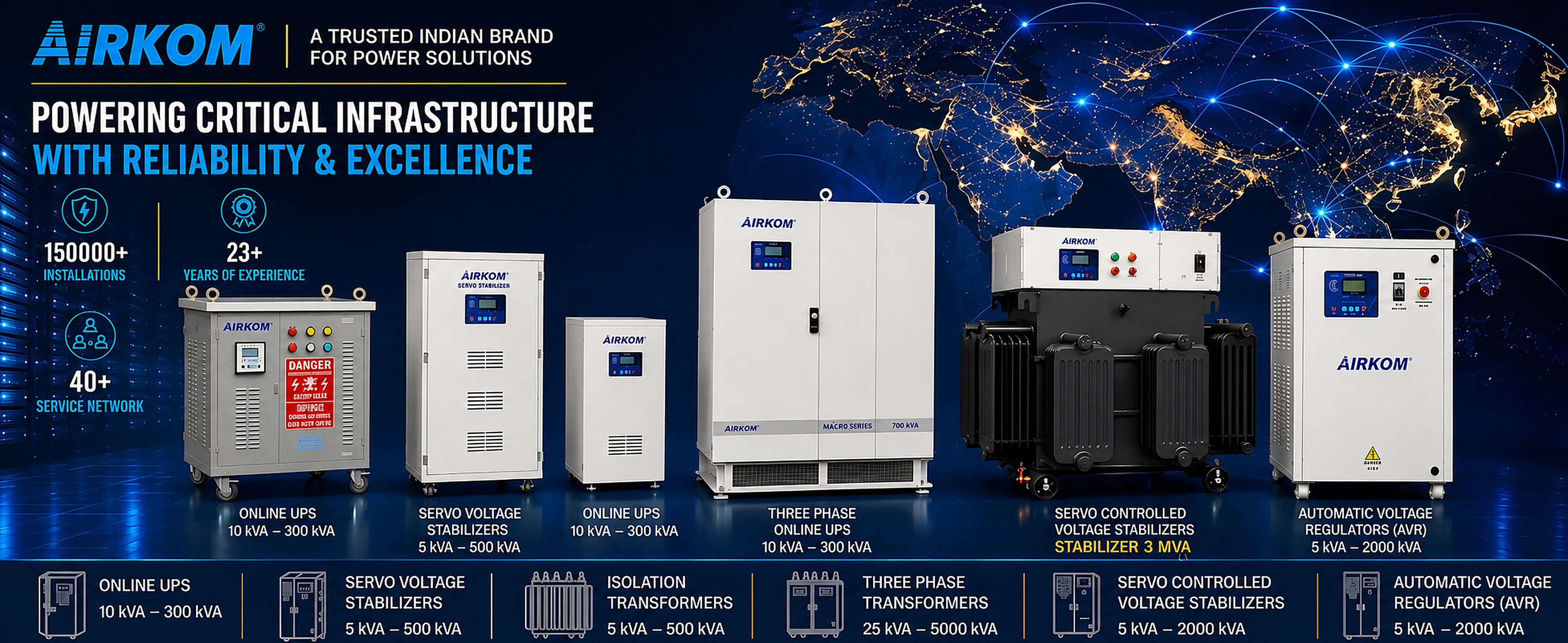
Sizing an uninterruptible power supply (UPS) for an industrial manufacturing plant is fundamentally different from sizing an IT server rack unit. In commercial offices, loads are predominantly linear and steady. In modern manufacturing plants, loads feature high-inrush electric motors, pulsed power supplies, variable-frequency drives (VFDs), welding machines, and sensitive PLC controllers.
An undersized UPS will trip into bypass mode or trigger inverter shutdown during motor startups. An oversized UPS, conversely, wastes valuable capital expenditure and operates at suboptimal partial-load efficiency, driving up annual electricity costs.
This engineering guide provides the exact formulas, load categorization methods, and battery sizing equations used by Airkom application engineers to specify reliable 3-Phase Online UPS systems.
1. The Step-by-Step kVA Sizing Formula
To determine the minimum required UPS capacity, follow this 4-step engineering protocol:
Step 1: Inventory Load Ratings in Watts (kW) and Apparent Power (kVA)
Examine nameplates or electrical single-line diagrams (SLD) to identify all equipment intended for the critical backup bus. If power is specified only in kilowatts (kW) or horsepower (HP):
- 1 HP ≈ 0.746 kW
- For each load, convert kW to kVA using the load's power factor (PF):
Apparent Power (kVA) = Active Power (kW) ÷ Power Factor (PF)(If power factor is unknown, use PF = 0.8 for mixed industrial machinery and PF = 0.9 for modern power-factor-corrected IT hardware).
Step 2: Account for Motor Starting Inrush Multipliers
Inductive loads such as conveyor motors, hydraulic pumps, cooling fans, and elevator drives draw starting inrush currents significantly higher than their rated full-load current (FLA):
- Direct-On-Line (DOL) Starting: Inrush is 5x to 7x full load current.
- Star-Delta Starting: Inrush is 2.5x to 3x full load current.
- Variable Frequency Drive (VFD) / Soft Starter: Inrush is 1.2x to 1.5x full load current.
Engineering Rule: To prevent the UPS inverter from saturating and transferring to utility bypass during starting sequences, stagger the startup of large motors or ensure the UPS peak overload capability (150% for 1 minute, 200% for 100ms) matches the largest instantaneous inrush step.
Step 3: Add Harmonic Distortion Crest Factor Headroom
Non-linear loads (rectifiers, welding inverters, switching power supplies) draw non-sinusoidal currents with high crest factors (peak current / RMS current > 2.5). Add a 15% harmonic de-rating factor if non-linear loads comprise greater than 50% of total connected capacity.
Step 4: Apply Future Expansion and Aging Margin
Industrial facilities typically expand production capacity over a 5-year horizon. Add a minimum 20% to 25% safety margin:
Design UPS kVA = (Total Steady State kVA + Inrush Allowance) × 1.252. Practical Industrial Sizing Example
Consider a precision automotive component testing cell containing:
- Two CNC Machining Centers: 2 × 15 kW at 0.85 PF = 35.3 kVA
- Hydraulic Pressure Unit (VFD soft-started): 7.5 kW at 0.8 PF = 9.38 kVA (with 1.3x inrush = 12.2 kVA)
- Industrial PLC Automation & SCADA racks: 4 kW at 0.9 PF = 4.44 kVA
- Inspection Lighting & Clean Air Blowers: 3 kW at 0.95 PF = 3.16 kVA
Calculation:
- Total Steady State Load: 35.3 + 9.38 + 4.44 + 3.16 = 52.28 kVA
- With 25% Design Margin: 52.28 × 1.25 = 65.35 kVA
- Recommendation: Select an Airkom 80 kVA or 100 kVA 3-Phase Online UPS (HX3 or i-HX3 Series). This provides ample headroom, absorbs starting spikes comfortably on the inverter, and leaves 35% growth capacity for supplementary machinery.
👉 Explore Airkom's 3-Phase Online UPS Systems (10 kVA to 300 kVA).
3. Battery Autonomy & Ampere-Hour (AH) Calculation
Once the UPS kVA is determined, calculate the battery bank capacity to deliver the required backup runtime (e.g., 30 minutes to bridge until the diesel generator syncs, or 120 minutes for shift completion).
The Battery AH Formula:
Required Battery Capacity (AH) = (Active Load in kW × Autonomy Hours) ÷ (Inverter Efficiency × DC Bus Voltage × Depth of Discharge)- Inverter Efficiency: Typically 0.92 to 0.94 for true double-conversion systems.
- DC Bus Voltage: High-capacity 3-phase industrial UPS units operate on a high-voltage DC bus (e.g., 384V DC or 480V DC, consisting of 32 or 40 numbers of 12V batteries in series).
- Depth of Discharge (DoD): Maximum safe discharge limit, typically 0.80 (80%) for VRLA/SMF batteries to preserve cycle life.
4. SMF (VRLA) vs. Lithium (LiFePO4) for Industrial Plants
| Factor | Sealed Maintenance Free (SMF / VRLA) | Lithium Iron Phosphate (LiFePO4) |
|---|---|---|
| Footprint & Weight | Heavy, requires dedicated battery room | 70% lighter, 60% smaller footprint |
| Cycle Life | 300 – 500 cycles at 80% DoD | 3,000 – 5,000+ cycles at 80% DoD |
| Calendar Lifespan | 3 to 5 years | 10 to 15 years |
| Recharge Speed | 8 – 10 hours for 90% recharge | 2 – 3 hours rapid recharge |
| Thermal Sensitivity | Degrades rapidly above 27°C | Stable and safe up to 45°C ambient |
| Initial Investment | Lower upfront cost | Higher upfront, lower 10-year TCO |
For heavy industrial manufacturing facilities with ambient factory floor temperatures exceeding 30°C, LiFePO4 batteries dramatically reduce total cost of ownership by eliminating air-conditioned battery room HVAC costs and battery replacements every 36 months.
Conclusion & Engineering Consultation
Correct UPS sizing prevents unexpected plant shutdowns and safeguards multi-crore CNC tooling. When in doubt, perform a comprehensive on-site power audit using power quality analyzers to capture actual peak inrush waveforms and harmonics.
Airkom engineers conduct turnkey electrical sizing audits across industrial estates throughout Maharashtra and Gujarat. Contact our engineering team in Mahape, Navi Mumbai or request a custom UPS engineering quotation.
Require Custom Sizing or Technical Specifications?
Airkom engineers provide complimentary load audits, harmonic calculations, and customized power protection proposals for manufacturing facilities.
Manufacturing precision servo stabilizers, online UPS systems, and power transformers since inception. Certified ISO 9001, ISO 14001, CE marked, and approved by NABL, STQC, and GeM. Plant located at Mahape, Navi Mumbai.